Handling Calls
This chapter is for the people on the phones: agents who take calls in the browser softphone, and supervisors who watch and assist live.
In the app: My Workspace (the softphone).
1. Before your first shift (agents)
A quick checklist so your first call goes smoothly:
- ✅ Browser: use Google Chrome (recommended).
- ✅ Headset & mic plugged in before you sign in.
- ✅ Your company's sign-in URL and your username/password (from your admin).
- ✅ When the browser asks to use your microphone, click Allow — without mic permission you can't be heard.
- ✅ If you'll use the pop-out softphone (Orbit Panel), allow pop-ups for the site.
Your literal first call, start to finish:
- Sign in at your company's URL.
- Open My Workspace (in-app softphone) — or Orbit Panel from the Workspaces menu (pop-out).
- Allow microphone access when prompted.
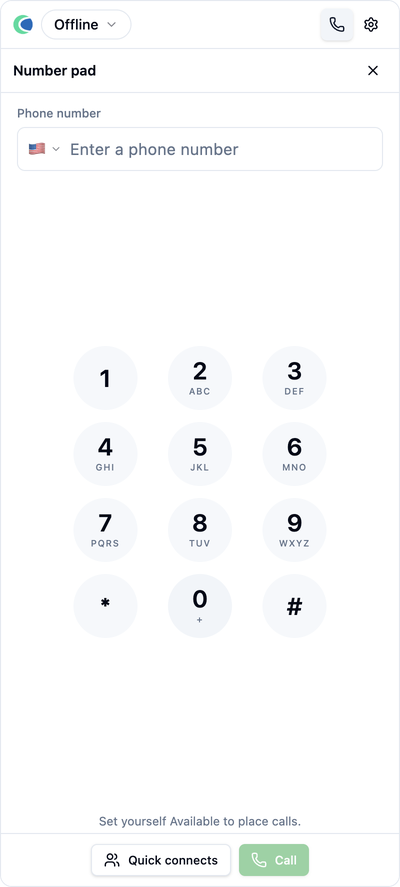
- Set your state to Available (presence control in the Call Bar / panel). Nothing rings until you're Available.
- When a call is offered, the softphone rings — click Accept.
If you see "softphone not available," your account hasn't been set up to take calls yet (it needs an agent routing profile and softphone access). Ask your admin to enable your softphone.
2. The softphone
Agents handle calls in a built-in WebRTC softphone — just your browser, a headset, and a mic. Orbit offers it in two forms:
| Form | Where | Best for |
|---|---|---|
| Orbit Workspace (in-app, "My Workspace") | inside Orbit | Working in Orbit — the softphone sits in the page and a Call Bar follows you on every screen, so you can browse records while on a call. |
| Orbit Panel (pop-out) | /orbit-panel, standalone window (~400×720) | A focused softphone you keep beside other apps. |
Switch between them from the header's Workspaces menu. They're mutually exclusive — one active at a time — and your state and current call carry over when you switch.
The Call Bar (bottom of every page in the in-app workspace) is your control strip: your current state, the call state (idle / ringing / connected), and the on-call controls below.
The gadget, screen by screen
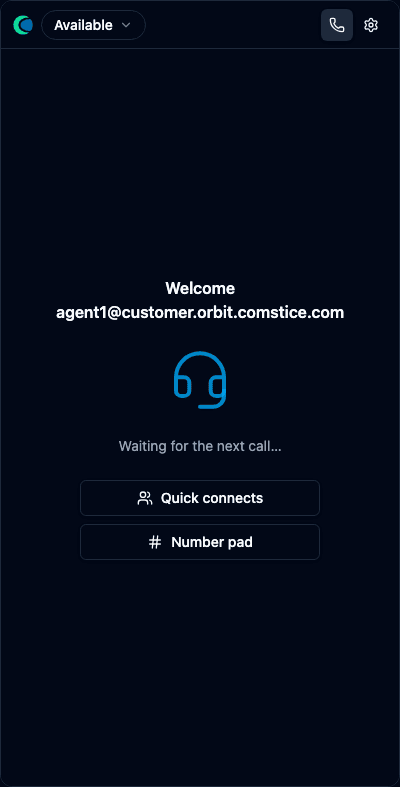
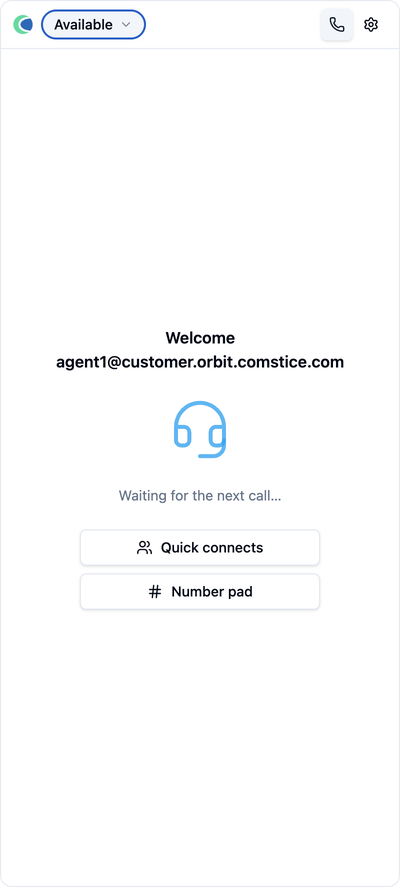
The screenshots below are the pop-out Orbit Panel (~400 px wide) — the same controls appear in the in-app Call Bar. This is the agent's whole day in one strip.
At rest — signed in and waiting
When you're Available the gadget shows a welcome, a headset, and "Waiting for the next call…", with shortcuts to Quick connects and the Number pad. The top bar always has your state dropdown, a dial icon, and ⚙ settings.
Set your state
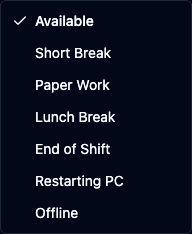
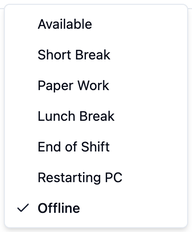
Open the state dropdown to switch between Available and your center's Not Ready reasons — Short Break, Paper Work, Lunch Break, End of Shift, Restarting PC — or Offline. Only Available receives inbound calls.
Settings & devices
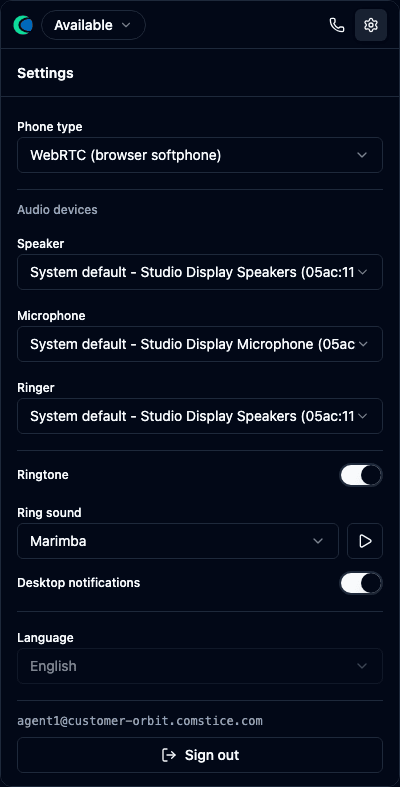
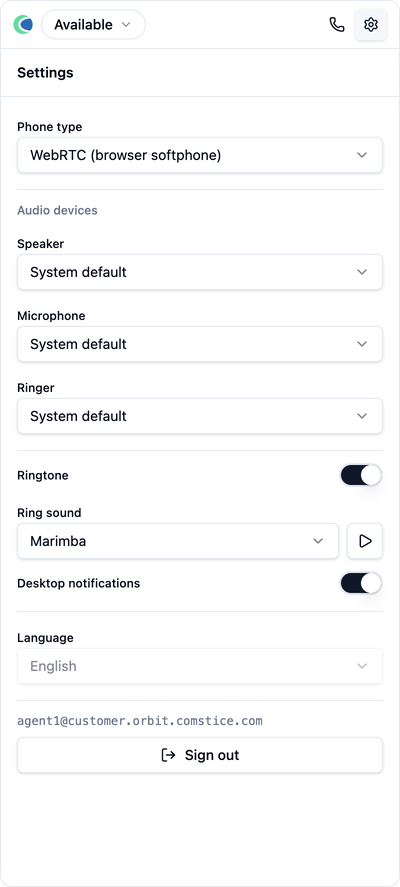
The ⚙ panel is where you pick your phone type (WebRTC browser softphone), your speaker / microphone / ringer devices, the ringtone, desktop notifications, My call settings (below), and Sign out. Set your headset here before your first call.
My call settings — DND & forwarding
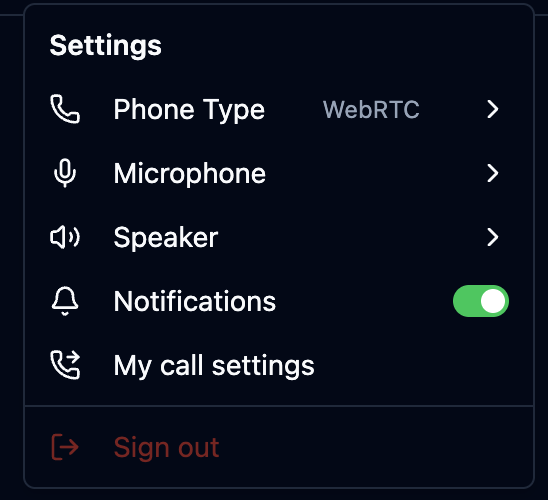
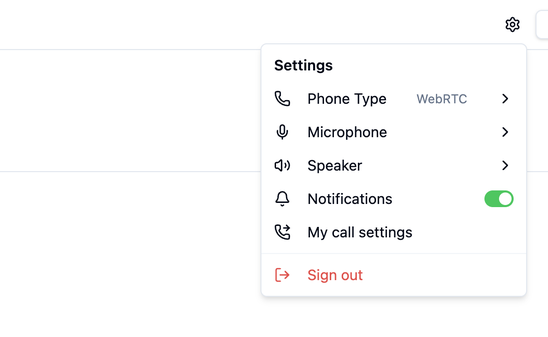
The ⚙ menu also has My call settings — your own rules for calls dialed directly to you (a colleague calling your extension, a transfer to you by name). These are personal preferences: every signed-in user has them, no admin permission needed.
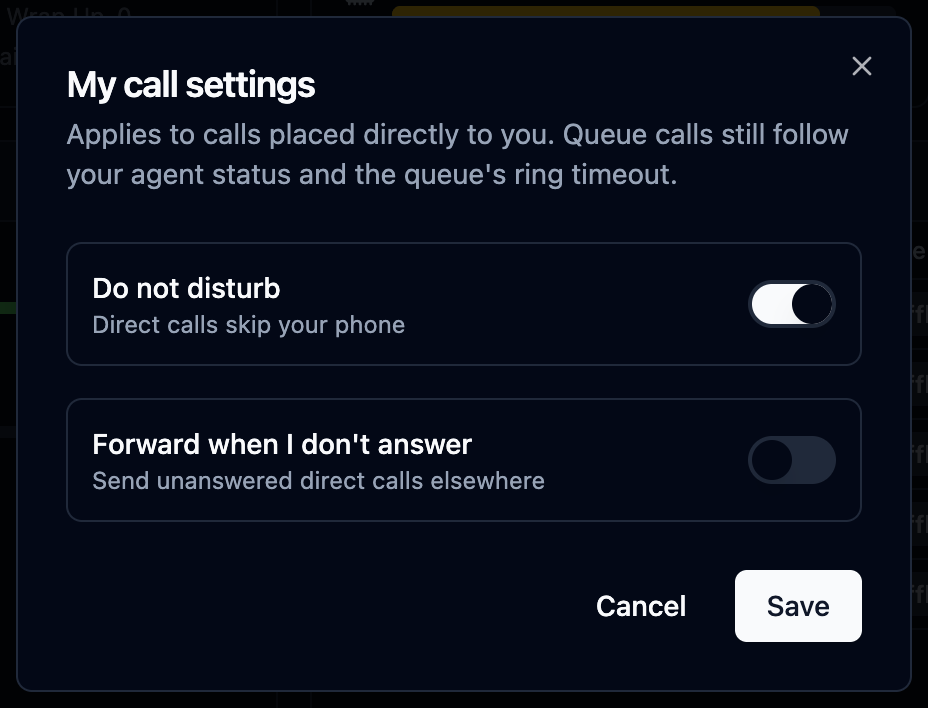
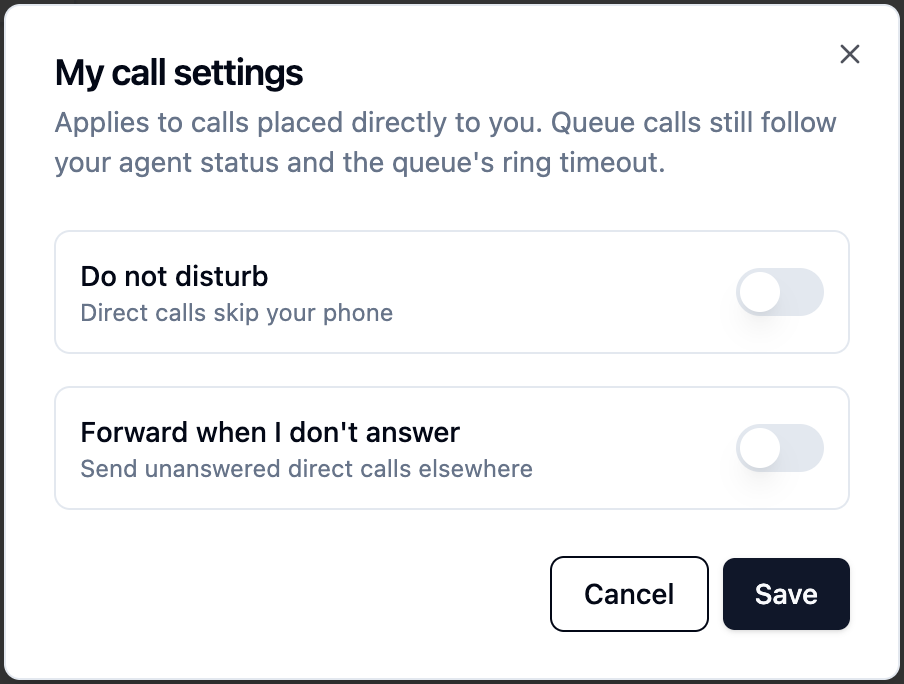
| Setting | What it does |
|---|---|
| Do not disturb | Direct calls skip your phone entirely. |
| Forward when I don't answer | Unanswered direct calls are sent elsewhere. Turning it on reveals two fields: |
| Forward to | Where they go — an external number (+1 415 555 0100) or an internal extension. |
| After (seconds) | How long your phone rings before forwarding (5–120, default 20). |
Click Save — you'll see "Call settings saved". If forwarding is on but the destination is empty, the dialog refuses to save ("Enter a forward destination").
As the dialog itself says: "Applies to calls placed directly to you. Queue calls still follow your agent status and the queue's ring timeout." DND here does not stop ACD work — whether queue calls reach you is governed by your state and the queue's RONA timeout. You can't opt out of the queue from this dialog, and that's deliberate.
Your softphone lives in a single browser tab. Opening the workspace in another tab (or another machine) offers a takeover — the new tab takes the session and the old one lets go, so two tabs never fight over your calls.
Dialing out
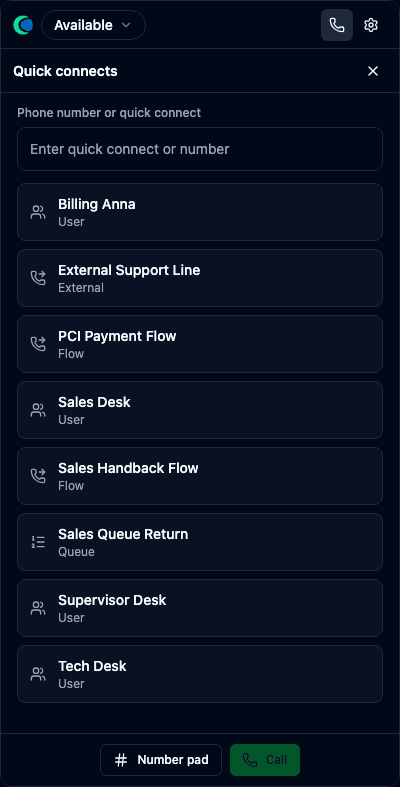
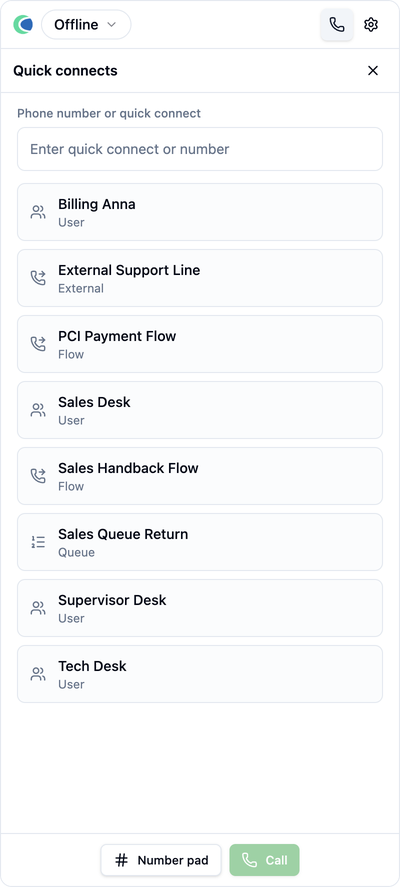
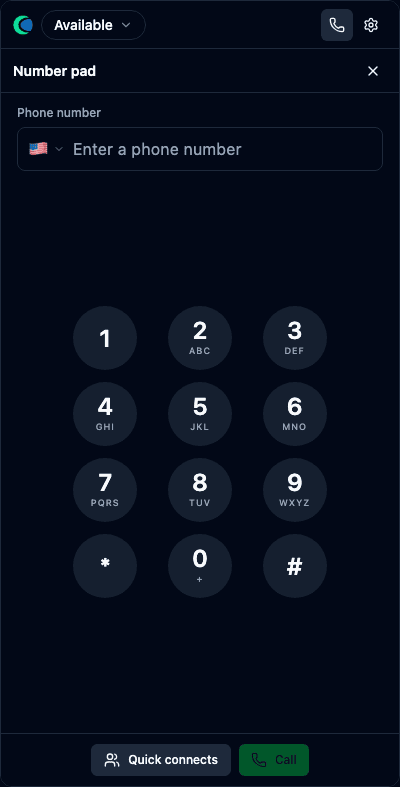
Two ways to place a call: Quick connects (named destinations your admin set up — colleagues, external lines, flows, queues) or the Number pad (type any number).
A call arrives
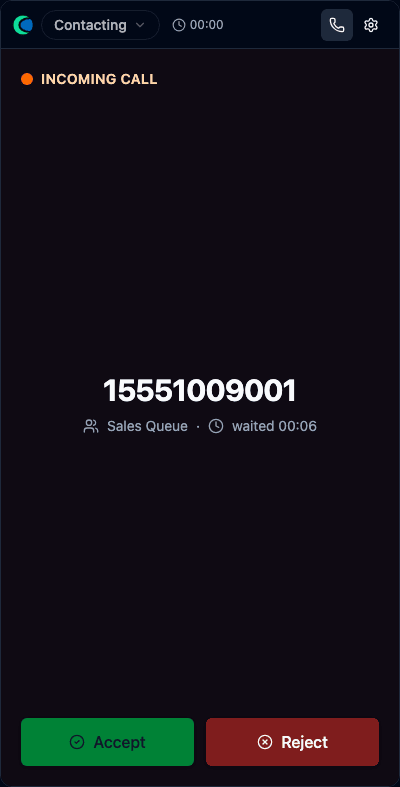
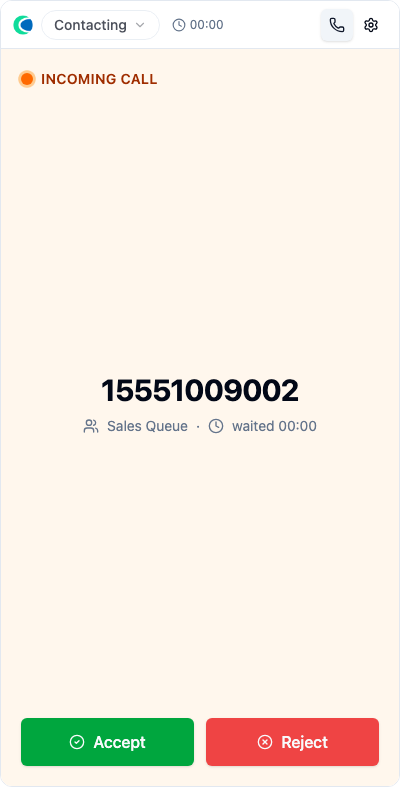
The gadget rings and shows INCOMING CALL with the caller's number, the queue it came from, and how long they waited. Click Accept to take it or Reject to send it back to the queue.
Simultaneous ring queues. If the queue uses simultaneous ring, the offer card carries an amber "⚡ SIMULTANEOUS — first to accept takes the call" badge — several agents are seeing this same call, and whoever clicks Accept first gets it. If a colleague beats you to it, your card closes on its own with a quiet "Call answered by another agent" notice. That's not a missed call — you stay Available and nothing is counted against you.
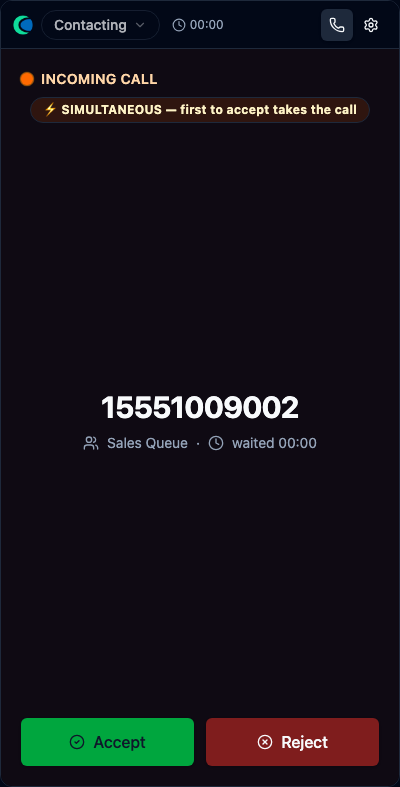
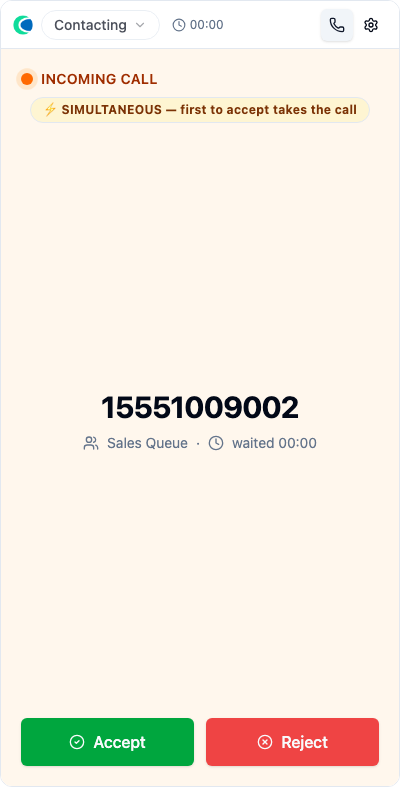
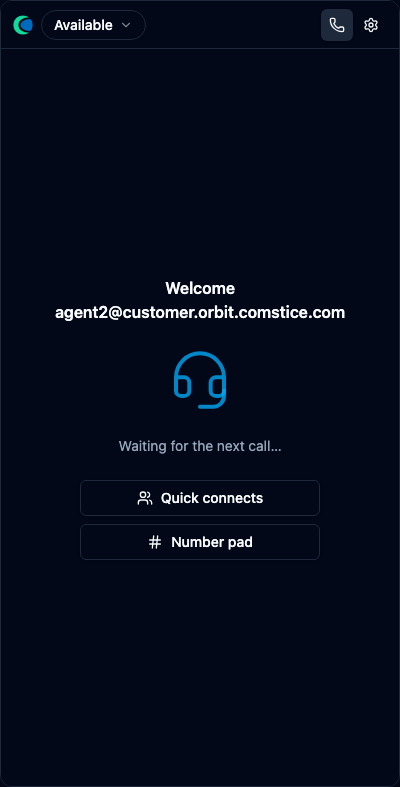
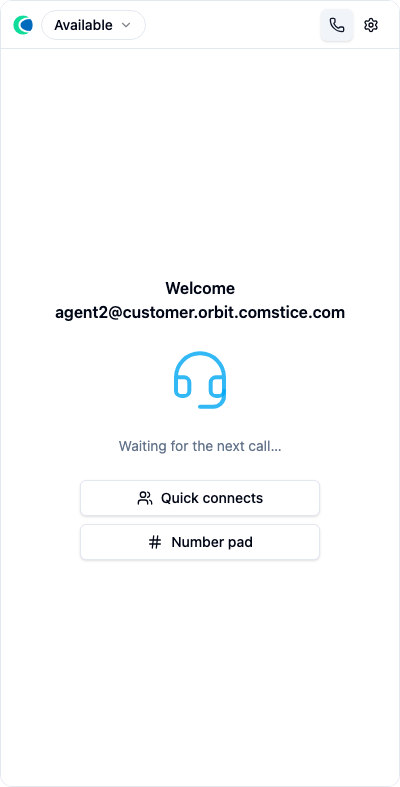
A colleague accepted first: the card closed by itself and the agent is simply Available again — no Missed state, nothing counted against them.
On the call
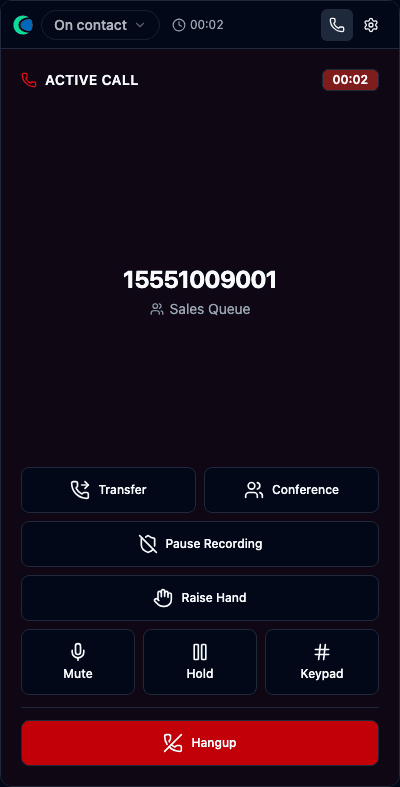
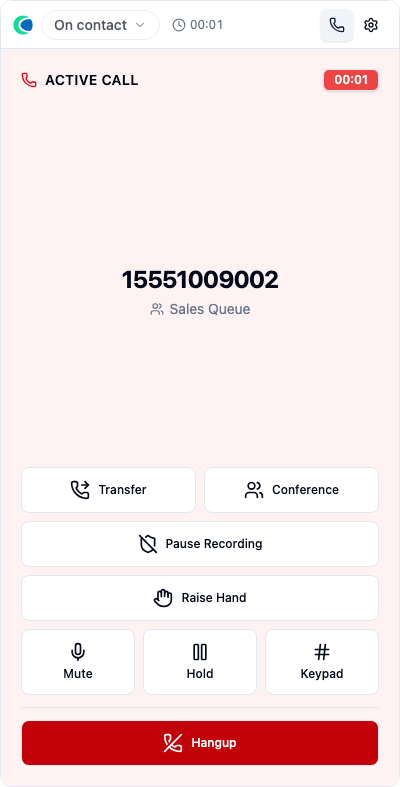
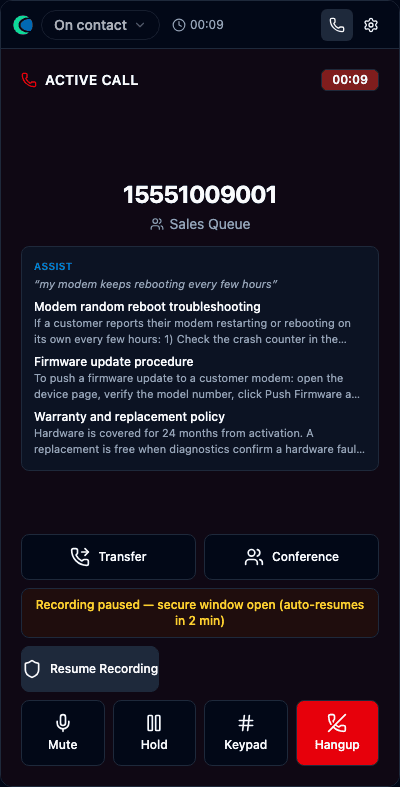
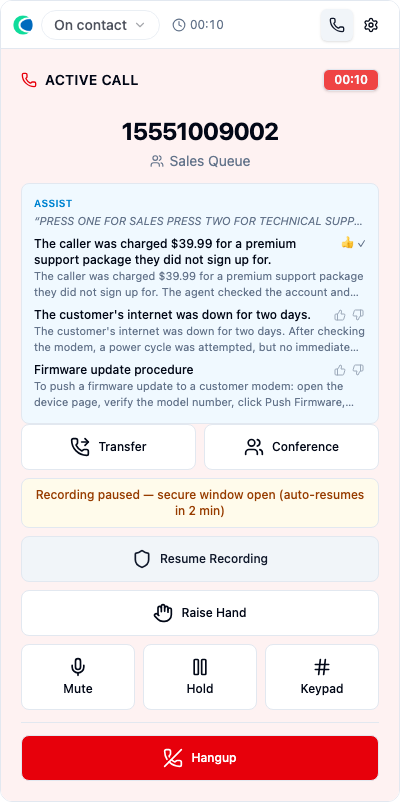
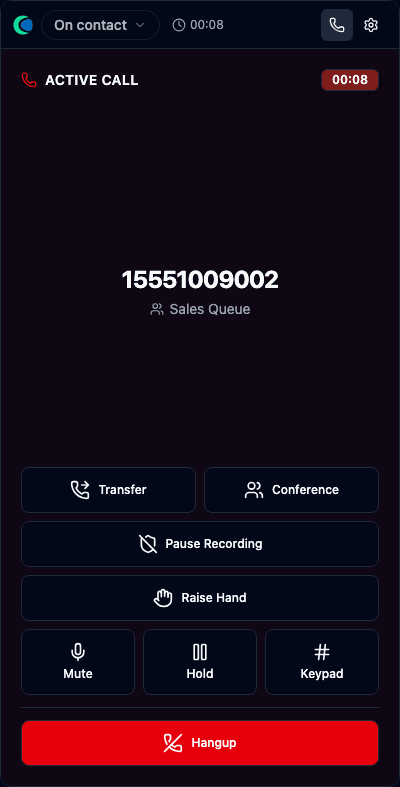
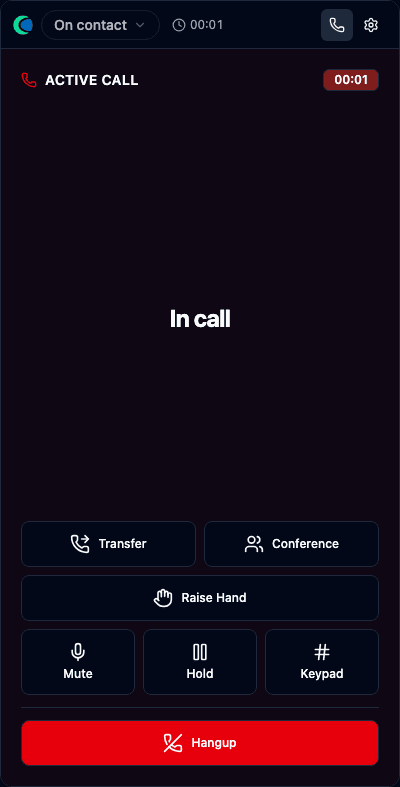
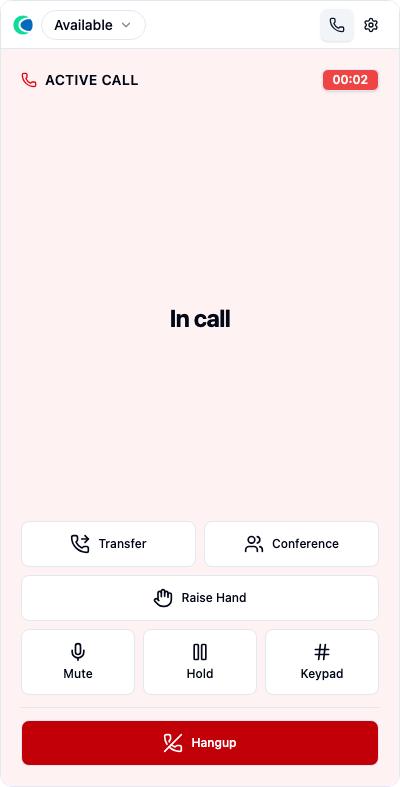
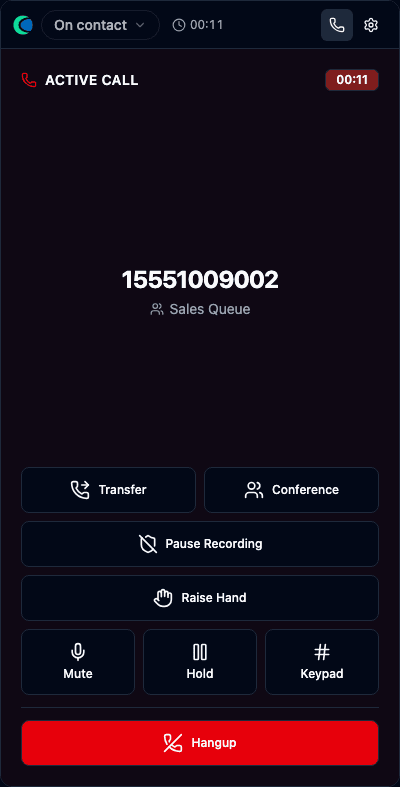
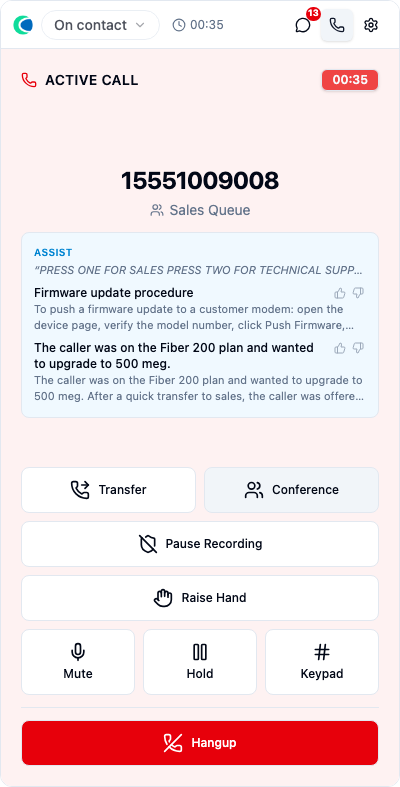
Once connected you see ACTIVE CALL with a live timer, the caller, and the queue. Your controls, top to bottom: Transfer and Conference, then Pause Recording, Raise Hand, and a row of Mute, Hold and Keypad (send DTMF).
Hangup sits alone on its own full-width red row at the bottom, deliberately away from everything else — so ending a live call is never a mis-click.
Who's calling — the CRM card. If your admin connected a CRM with screen-pop (Settings → CRM), a blue customer card appears under the caller's number — their name, a small badge for the CRM it came from, and their Plan and Account if known. It can pop while ringing or on answer (admin's choice). The lookup never slows the call down: if the CRM is slow or finds nothing, the card simply doesn't appear.
Agent-assist (live help)
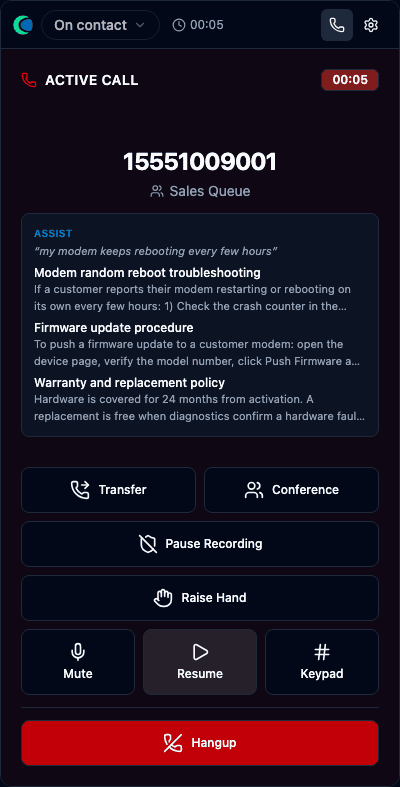
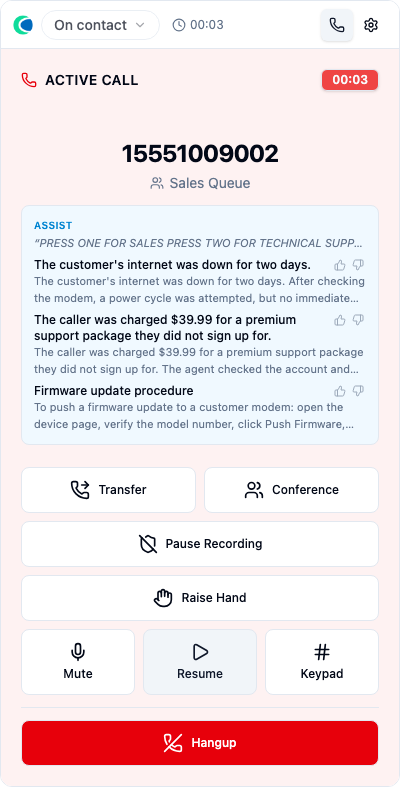
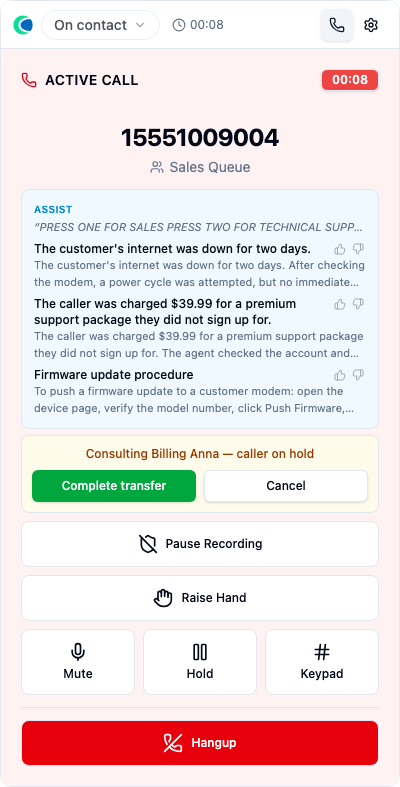
While you talk, Orbit listens and quietly surfaces relevant knowledge-base snippets in an ASSIST panel — matched to what the caller just said — so newer agents answer like veterans.
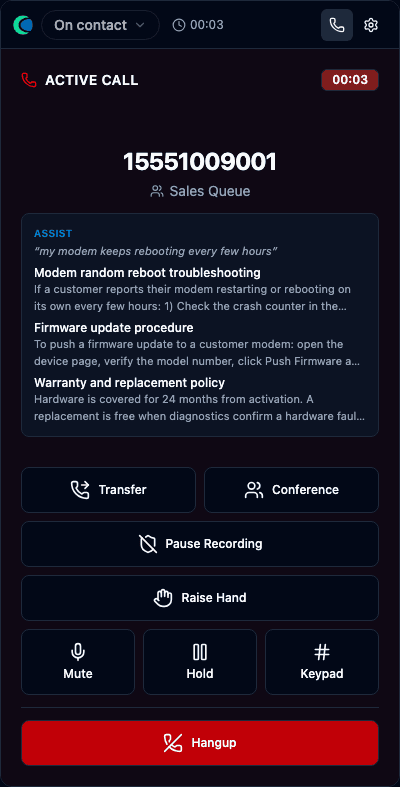
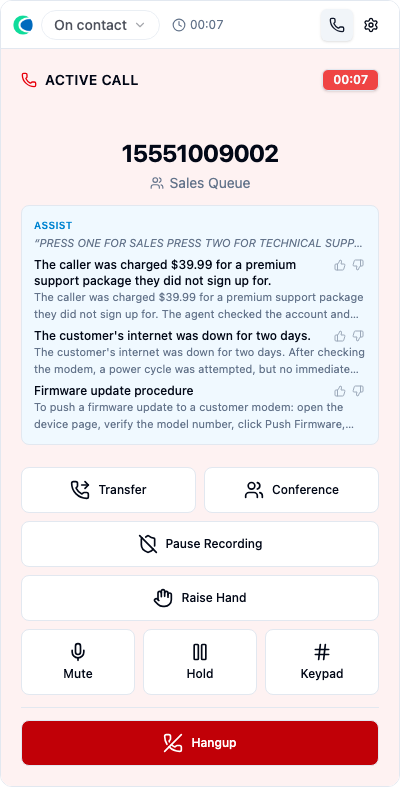
Each suggestion carries a 👍/👎 — rating them is what teaches the pool which articles actually help on a live call. See Knowledge Base for where those votes land, and Agent Assist for how the suggestions are produced.
Raise your hand for help
Stuck mid-call and you need a supervisor now? Press Raise Hand. You get a "Hand raised — your supervisor has been notified" confirmation, and your supervisor gets an alert they can't miss and can jump straight into the call — you never have to leave the customer to go find someone.
The button turns amber and reads Lower Hand while your hand is up; press it again to put it down. It's tied to this call — when the call ends the hand drops by itself, so it never carries over to the next customer.
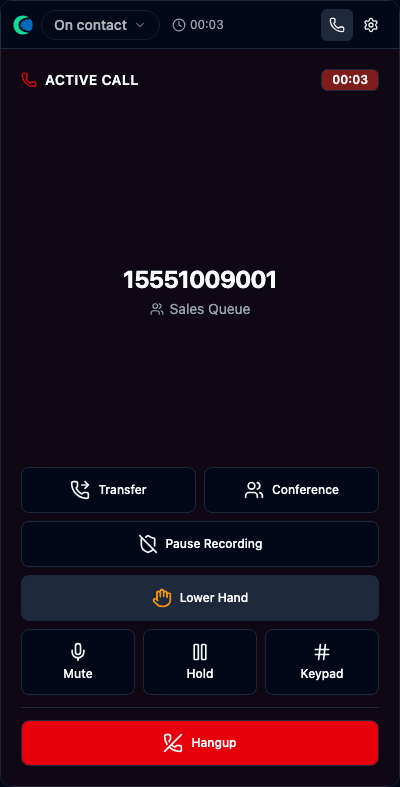
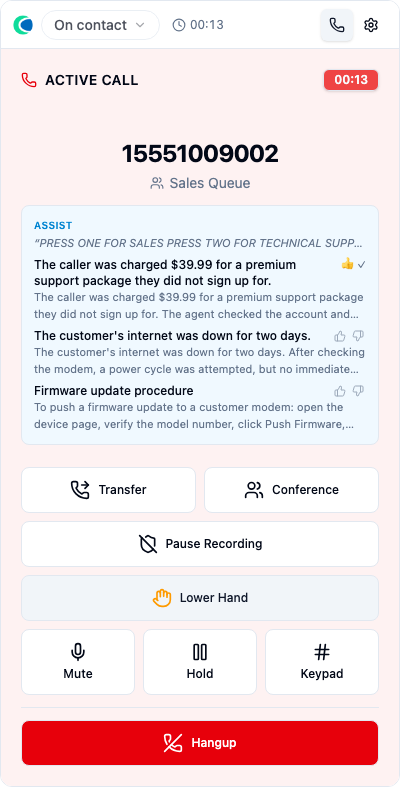
A raised hand shows up as a must-see alert on every supervisor's screen and marks you HAND RAISED in their Live Monitor, so they can open your call and listen, whisper or barge.
Hold & resume
Hold parks the caller (they hear your queue's hold experience); the button becomes Resume to bring them back. Avoid long holds.
Secure pause (PCI)
Press Pause Recording at a payment moment: the recording is masked and a banner shows "Recording paused — secure window open (auto-resumes in 2 min)", with a Resume Recording button. Card details never reach the stored audio. (This button only appears if your flow enabled the Agent Capabilities → Pause Recording for the call.)
Transferring
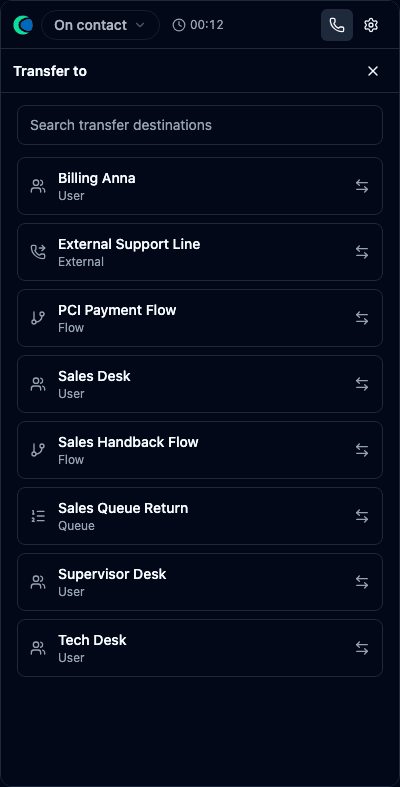
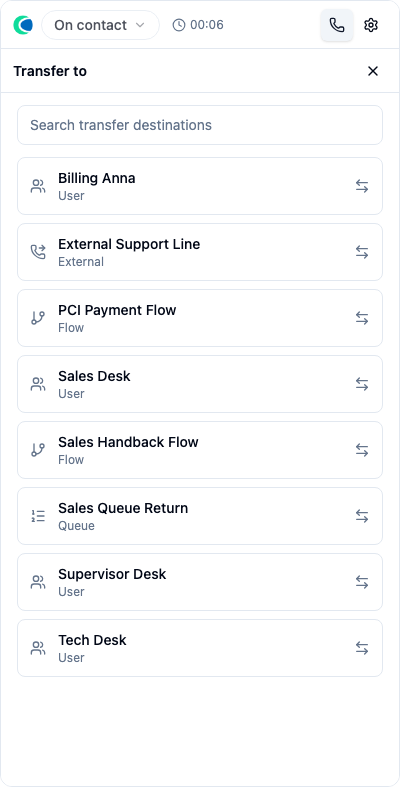
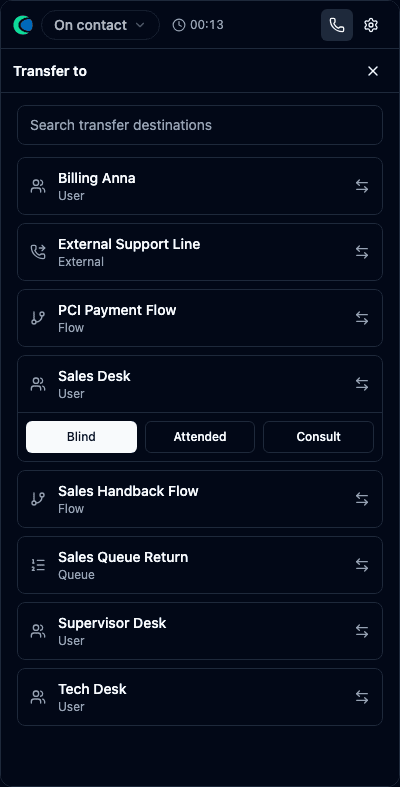
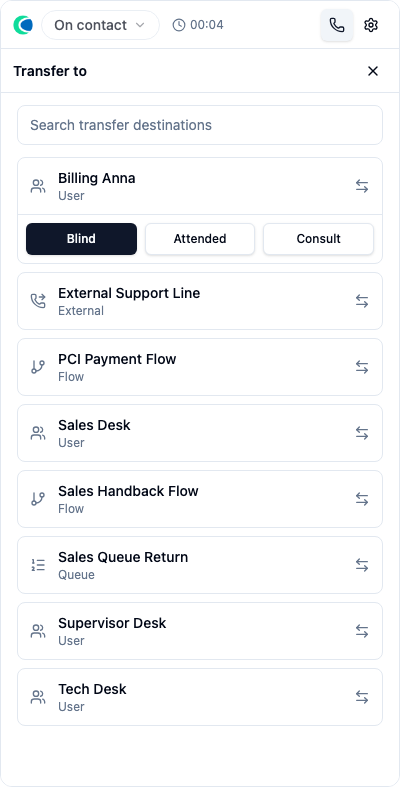
Transfer opens a searchable list of destinations. Pick one and choose the type: Blind (send immediately), Attended (talk first, then complete), or Consult (a private consult you can turn into a transfer or conference).
Consult & conference across agents
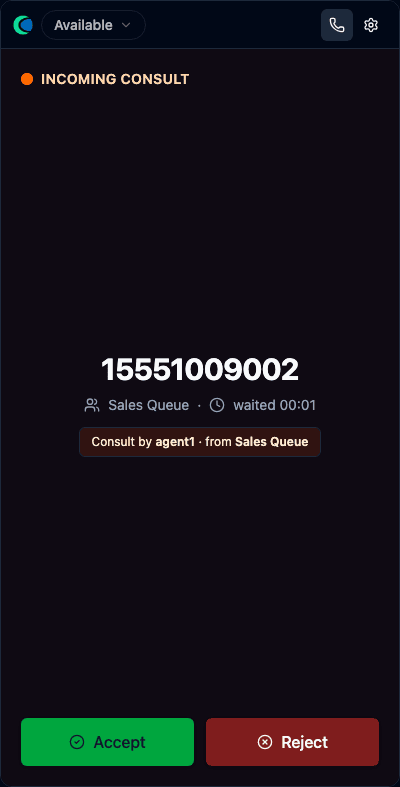
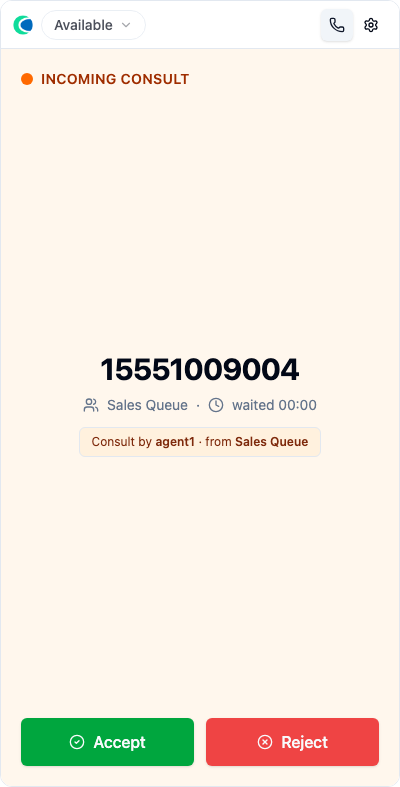
When you Consult a colleague, their gadget shows INCOMING CONSULT — "Consult by you · from queue" — so they know it's an internal consult, not a new customer. Accept, and you two talk privately (the caller is held); then complete the transfer or start a Conference so all three are on the line together.
Wrap-up — the disposition form, inside the gadget
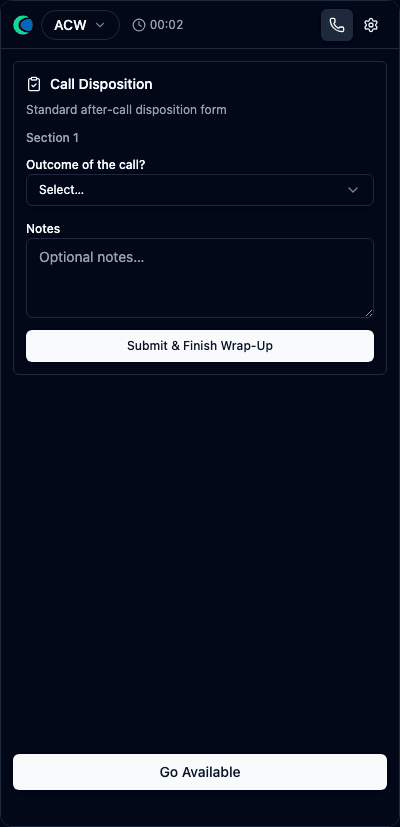
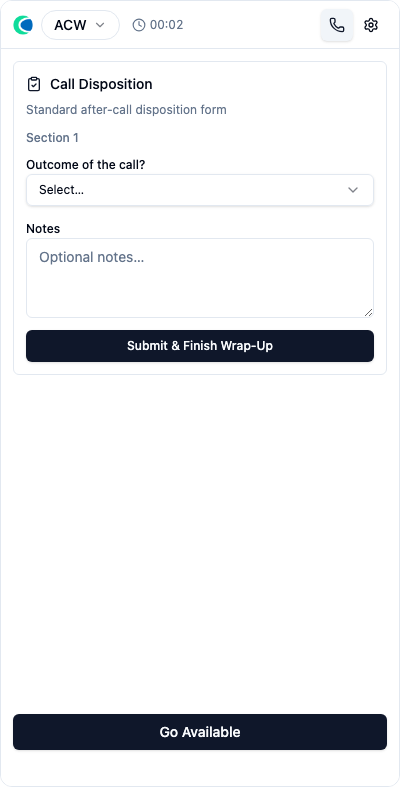
When the call ends you go straight into ACW (wrap-up) and, if your queue has a Wrap-Up form, the form opens inside the softphone itself — the same place the Assist panel appears, not a separate column beside it. Pick the outcome/disposition, add notes, and Submit & Finish Wrap-Up.
Two things worth knowing:
- Only two actions exist here — Submit & Finish Wrap-Up in the form, and Go Available pinned at the bottom. Quick connects and the Number pad are hidden during wrap-up so nothing competes with finishing the call.
- Go Available never loses your work. If you leave without pressing Submit, whatever you had selected (or left blank) is saved anyway, then you go Available for the next call.
A long form doesn't push Go Available off-screen: the form area scrolls on its own while the button stays put.
3. Handling a live call
When a call is offered to you, the softphone rings.
| Action | What you do | What the caller experiences |
|---|---|---|
| Accept | Click Accept on the ringing softphone. | You're connected; any agent-whisper plays to you first (a short announcement naming the queue the call came from). |
| Reject / no-answer | Click Reject, or let it ring out. | The call goes back to the queue for the next agent. You land in the Missed state — new calls stop being offered to you until you set yourself Available again (see §6). |
| Mute | Toggle Mute to silence your mic. | They can't hear you; they still hear the live call (not hold music). Use it to cough or ask a colleague. |
| Hold / Resume | Hold parks the caller; Resume brings them back. | They hear your queue's hold experience (music/announcements). Avoid long holds. |
| Keypad (DTMF) | Open the Keypad to send key tones. | Tones are sent down the line — used to drive an external IVR (e.g. when transferring to a system that asks for an extension). |
| Hang up | Click Hangup to finish. | The call ends; you move into Wrap-up (below). If the caller hangs up first, you still get wrap-up time. |
Rejecting or missing a ringing call doesn't drop the customer — the ACD re-queues them for the next available agent (see Queues & ACD). It may count toward your miss stats.
4. Transfers & conference
Transfers are the most error-prone agent action, so know the types. When you pick a destination, the gadget offers three of them (shown in the softphone tour):
| Transfer type | What it means | When to use |
|---|---|---|
| Blind (cold) | Send the caller away immediately — you drop off, no briefing. | You're sure where they should go and don't need to brief anyone. |
| Attended (warm) | Talk to the destination first (the caller is on hold), then complete — the caller connects and you drop. | You want to introduce the caller or check the person is available. |
| Consult | A private consult with the destination (caller held) that you can then turn into a completed transfer, cancel back to the caller, or merge into a conference. | You may need to come back to the caller, or keep everyone on the line. |
The destination can be a colleague, a queue, an external number or a flow — that's what the Quick Connects list your administrator maintains defines.
How an attended/consult transfer plays out: start the transfer → the caller goes on hold → you reach the destination and brief them → complete to connect them and drop yourself, or cancel to pull the caller back if the destination can't take it.
Conference (3-way): from a Consult, press Conference to bring the caller into the bridge so everyone hears each other (you, the caller, and the third person). Use it when the caller needs to stay on the line while you bring in help, rather than handing them off. If one party drops, the other two keep talking. The receiving agent sees an INCOMING CONSULT card first — the softphone tour shows both sides.
If you started an attended transfer and the destination can't help, use cancel / pull-back to return to the caller — don't just hang up, or you'll drop the customer.
Transfer, consult and conference behave identically on manual outbound calls — inbound and outbound share the same transfer machinery.
5. Wrap-up (after-call work)
When a call ends you enter Wrap-up — also called After Contact Work (ACW) — protected time to finish notes before the next call rings.
- If your queue uses a Wrap-Up form, it appears automatically inside the softphone: pick a disposition/reason, add notes, flag a callback if needed, then submit.
- The wrap-up timer is set per queue (e.g. 30 seconds; 0 = none). You can usually finish early to go straight back to Available. When the timer expires you return to Available automatically — so submit your notes before then.
- Your wrap-up notes later appear in the call's Call Review.
6. Your status (presence)
Your state tells the system whether to send you calls. Change it from the presence control in the Call Bar / panel.
| State | Meaning |
|---|---|
| Available | Ready — calls can ring you. |
| Ringing | A call is being offered (set automatically). |
| On call | You're talking to a customer (automatic). |
| Wrap-up | After-call work (automatic after a call). |
| Missed | You rejected — or didn't answer — an offered call. Sticky: no new calls are offered until you set yourself Available again. |
| Not ready / Break / Lunch | Signed in but not taking calls. |
| Offline | Not signed in to the softphone. |
- You must be Available for any call to ring — a new agent sitting in Not Ready will wonder why it's silent.
- Missed is the #1 "why did my phone go quiet" cause. One missed or rejected offer parks you in Missed deliberately (so the queue stops ringing someone who isn't picking up) — and it stays until you flip yourself back to Available. If calls stopped after you missed one, check your state first.
- Some centers require a reason when you go Not Ready (e.g. Break, Lunch, Training). If your center uses reason codes, pick one when prompted.
- Auto-transitions: answering moves you Ringing → On call; ending a call moves you to Wrap-up → Available.
- A supervisor can change your state (e.g. pull you out of Break, or move you from Missed back to Available) from the Agent States roster — if your state changes on its own, that's likely your supervisor.
- DND affects only calls dialed directly to you — see My call settings. Queue calls follow your state, always.
- End of your shift: finish (or wrap up) your last call, set yourself Offline, then Sign out from the ⚙ menu. Going Offline first keeps a ringing offer from chasing a closing browser tab.
7. Outbound & callback
Manual outbound (click-to-dial)
Open the Number pad (or a quick connect), enter the number, and place the call (shown in the softphone tour). A manual call is your call — it is not part of any campaign:
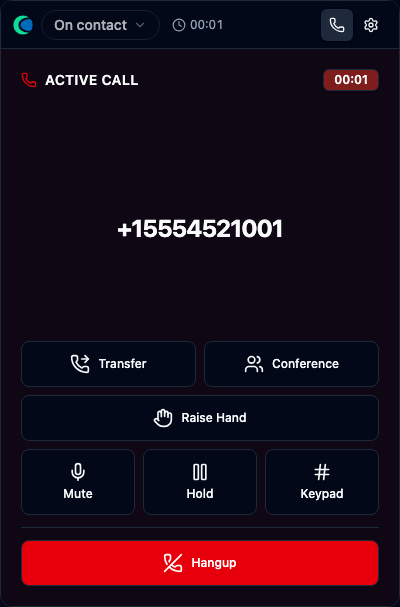
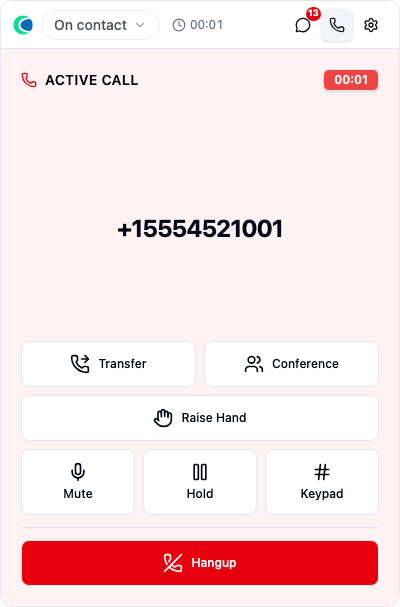
- No queue label. An inbound call shows its queue (e.g. Sales Queue) at the top; a manual outbound call shows just the dialed number. That's the quickest way to tell them apart.
- The caller ID the customer sees comes from your routing profile's default outbound queue — ask your admin if unsure.
- Everything else works exactly like an inbound call: recording, transfer, consult & conference, hold, wrap-up, and your supervisor can monitor it live.
Click-to-dial goes through its own path — it never inherits campaign pacing, contact lists or dispositions. Campaign calling (where the dialer places calls from a contact list) is covered in Outbound Campaigns & Dialer.
Queued callback — you accept first, then the customer is dialed
If a queue offers "press 1 for a callback instead of waiting," the caller hangs up and keeps their place in line. When their turn comes you are rung first:
- A callback offer card appears in your gadget (like an incoming call, but labelled as a callback) — Accept or Reject, with about 25 seconds to decide.
- On accept you hear a short whisper telling you who you're about to call.
- Only then does Orbit dial the customer — you're already on the line when they answer, so there's no dead air on their end.
- Rejecting (or missing) the offer doesn't burn the callback — it goes back into the queue after a short cooldown and is offered to the next available agent. The customer's attempt counter doesn't move.
- Some queues enable auto-accept for callbacks: you're not asked, the whisper plays, and the customer is dialed straight away. Whether that's on is a per-queue admin choice.
10. When you're being monitored (agents)
It's normal to be monitored — here's what each mode feels like from your seat:
| Mode | What you experience |
|---|---|
| Monitor | Nothing. Your supervisor listens silently; you and the caller are unaware. |
| Whisper | You hear your supervisor's voice coaching you — the caller cannot hear them. A coaching prompt may appear on screen. |
| Barge | Your supervisor joins the call and both you and the caller can hear them — it becomes a 3-way conversation. |
| Intercept | Your supervisor takes the call over and you are removed from it. Your call simply ends on your side; the customer keeps talking to the supervisor. |
If you suddenly leave a call you didn't end, it was likely an Intercept — your supervisor stepped in. Nothing is wrong on your side.
11. Compliance during the call (agents)
- Recording disclosure / consent: depending on your center's policy, callers may hear a "this call may be recorded" announcement automatically, or you may be asked to confirm consent. If your center uses explicit consent, follow your script and your supervisor's guidance on what to do if a caller declines.
- Card numbers / payments: if your flow uses Secure Input (PCI), the recording is automatically masked while the caller types their card — you don't have to do anything. If your center hasn't enabled that yet, follow your center's manual procedure for taking card details (don't assume the system is masking). See Compliance.
12. Your performance (agents)
- My Evaluations (Quality → My Evaluations): open it to see evaluations of your own calls. For each one you can read the scorecard and either Acknowledge it or Dispute it with a reason. A dispute is sent to your supervisor to review — it's not an unappealable score. See Quality Assurance.


My Evaluations: your own QA results — the scorecard, the score, and a status (submitted / acknowledged). Use Acknowledge to accept a score, or Dispute to send it back to your supervisor with a reason.
- Your stats: the Dashboard shows your own numbers (your calls handled, AHT, sentiment) — scoped to you.
- Your calls' recordings/transcripts/sentiment: whether you can open your own call recordings, transcripts, and sentiment depends on the permissions your admin grants your agent profile. If you need them to prepare for coaching or a dispute, ask your admin to enable recording/transcript view for agents.
13. If something goes wrong (agents)
| Problem | What to do |
|---|---|
| No audio / one-way audio / echo | Check your headset is selected as the mic and speaker; re-check the browser mic permission; reload and sign in again. |
| Mic permission was denied | Click the camera/mic icon in the browser address bar → allow the microphone → reload. |
| Softphone disconnected / "reconnecting" | Wait a few seconds — it reconnects automatically. If it doesn't, reload the page and sign back in. |
| Browser refreshed mid-call / tab closed | A refresh can drop an active call. If you lose the customer, follow your center's callback procedure. Avoid refreshing while on a call. |
| Network blip | Brief drops recover; a longer outage ends the call — set yourself Not Ready until your connection is stable. |
| Pop-out Panel won't open | Your browser's pop-up blocker is on — allow pop-ups for the Orbit site. |
If you're stuck on a live call and need help, ask your supervisor — they can whisper guidance to you without the caller hearing.